Attic Pull-down Ladders
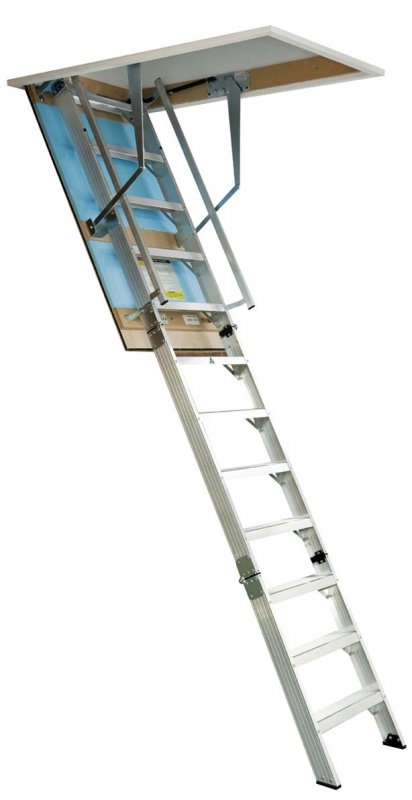
 without being required to carry a portable ladder.
Homeowners, not professional carpenters, usually install attic pull-down ladders. Evidence of this distinction can be observed in consistently shoddy and dangerous work that rarely meets safety standards. Some of the more common defective conditions observed by inspectors include:
- cut bottom cord of structural truss. Often, homeowners will cut through a structural member in the field while installing a pull-down ladder, unknowingly weakening the structure. Structural members should not be modified in the field without an engineer’s approval;
- fastened with improper nails or screws. Homeowners often use drywall or deck screws rather than the standard 16d penny nails or ¼” x 3” lag screws. Nails and screws that are intended for other purposes may have reduced shear strength and they may not support pull-down ladders;
- fastened with an insufficient number of nails or screws. Manufacturers provide a certain number of nails with instructions that they all be used, and they probably do this for a good reason. Inspectors should be wary of “place nail here” notices that are nowhere near any nails;
- lack of insulation. Hatches in many houses (especially older ones) are not likely to be weather-stripped and/or insulated. An uninsulated attic hatch allows air from the attic to flow freely into the home, which may cause the heating or cooling system to run overtime. An attic hatch cover box can be installed to increase energy savings;
- loose mounting bolts. This condition is more often caused by age rather than installation, although improper installation will hasten the loosening process;
- attic pull-down ladders are cut too short. Stairs should reach the floor;
- attic pull-down ladders are cut too long. This causes pressure at the folding hinge, which can cause breakage;
- improper or missing fasteners;
- compromised fire barrier when installed in the garage;
- attic ladder frame is not properly secured to the ceiling opening;
- closed ladder is covered with debris, such as blown insulation or roofing material shed during roof work. Inspectors can place a sheet on the floor beneath the ladder to catch whatever debris may fall onto the floor; and
- cracked steps. This defect is a problem with wooden ladders.
- In sliding pull-down ladders, there is a potential for the ladder to slide down quickly without notice. Always pull the ladder down slowly and cautiously.
Relevant Codes
The 2009 edition of the International Building Code (IBC) and the 2006 edition of theInternational Residential Code (IRC) offer guidelines regarding attic access, although not specifically pull-down ladders. Still, the information might be of some interest to inspectors.
2009 IBC (Commercial Construction):
1209.2 Attic Spaces. An opening not less than 20 inches by 30 inches (559 mm by 762 mm) shall be provided to any attic area having a clear height of over 30 inches (762 mm). A 30-inch (762 mm) minimum clear headroom in the attic space shall be provided at or above the access opening.
2006 IRC (Residential Construction):
R807.1 Attic Access. Buildings with combustible ceiling or roof construction shall have an attic access opening to attic areas that exceed 30 square feet (2.8m squared) and have a vertical height of 30 inches (762 mm) or more. The rough-framed opening shall not be less than 22 inches by 30 inches, and shall be located in a hallway or readily accessible location. A 30-inch (762 mm) minimum unobstructed headroom in the attic space shall be provided at some point above the access opening.
- Do not allow children to enter the attic through an attic access. The lanyard attached to the attic stairs should be short enough that children cannot reach it. Parents can also lock the attic ladder so that a key or combination is required to access it.
- If possible, avoid carrying large loads into the attic. While properly installed stairways may safely support an adult man, they might fail if he is carrying, for instance, a bag full of bowling balls. Such trips can be split up to reduce the weight load.
- Replace an old, rickety wooden ladder with a new one. Newer aluminum models are often lightweight, sturdy and easy to install.
In summary, attic pull-down ladders are prone to a number of defects, most of which are due to improper installation.